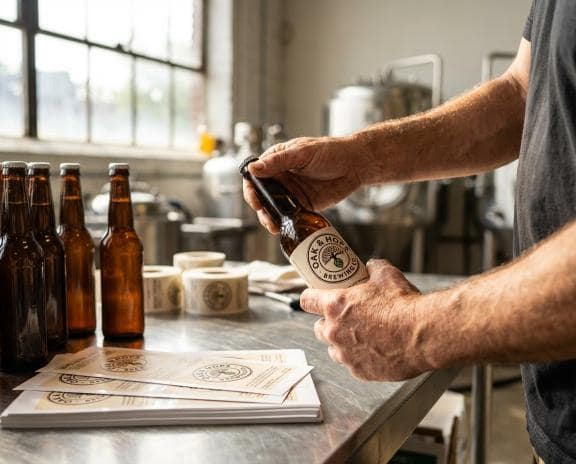
For a UK craft brewery, the bottle label is more than packaging — it’s your shelf presence, your brand story, and a legal compliance document, all in one piece of vinyl. Get it right and your bottles get picked up. Get it wrong and they get passed over, or worse, pulled by Trading Standards.
This guide covers everything UK craft breweries need to know about ordering custom bottle labels — material choice, compliance, design considerations, and how to get production-ready labels at a price that works at small-batch volumes.
What makes a great craft beer bottle label
UK craft beer drinkers are sophisticated. They’ve seen thousands of labels. The ones that get picked up share four characteristics:
- Strong primary mark. Either a bold beer name or a striking visual that reads at 2 metres on a shelf.
- Clear style identification. Pale Ale, IPA, Stout, Porter — readable instantly. Don’t make customers hunt for what kind of beer it is.
- Distinctive brand voice. Whether it’s BrewDog’s aggressive copy or Verdant’s mystical illustration style, every successful brewery has a recognisable look.
- Compliance information without ruining the design. All the legally required information present, but visually subordinated to the brand.
Label material: what works for beer bottles
Premium waterproof vinyl (recommended)
Our standard choice for craft breweries. Survives the ice bucket, condensation, fridge transfer, and consumer handling without smudging or peeling. Available in gloss for vibrant colour pop, or matte for a more “considered” craft feel.
Vinyl wraps cleanly around 330ml and 500ml bottles, handles the slight curvature of standard British beer bottles, and prints colour accurately. Most successful UK craft breweries use vinyl for both bottles and cans.
Transparent vinyl for a “no-label” look
If you want the beer colour to show through, or want a minimalist aesthetic where the design appears to float on the glass, transparent labels work brilliantly. Particularly effective for clear-bottled lagers, ciders, and lighter ales where the liquid colour is part of the visual story.
Paper labels (avoid for fridges)
Paper labels look “craft” and feel authentic, but they fail in fridges. Condensation soaks paper labels in hours, the print smudges, and they peel. Unless you’re selling exclusively at room-temperature events, vinyl outperforms paper at every level.
Label shapes for beer bottles
Three common formats work for craft breweries:
1. Single rectangular front label
Sits on the front belly of the bottle. Standard, clean, easy to design for. Typical size: 80×100 mm for 330ml bottles, 90×120 mm for 500ml. Allows for either a back label (with ingredients and brewery info) or to wrap the legal info around the bottle on a separate strip.
2. Front + back label combo
The classic approach. Front label is pure branding; back label carries ingredients, ABV, brewer’s notes, and barcode. Gives you more space for storytelling on the back. Slightly more expensive than a single label but standard in the industry.
3. Wrap-around label
Single label wraps the full circumference of the bottle. More dramatic visual impact but harder to design for (need to handle the seam carefully) and harder to apply accurately. Best for breweries with strong in-house design capability or who use commercial bottling lines.
UK legal requirements on craft beer labels
Every craft beer label must include:
- Product name: e.g. “Citra Pale Ale” or “Coffee Stout”
- Alcohol by volume: “5.2% ABV” or “5.2% vol”
- Net volume: “330 ml” or “500 ml”
- Ingredients list: in descending order of weight (e.g. “Water, malted barley, hops, yeast”)
- Allergen declarations: any of the 14 UK regulated allergens highlighted (gluten from barley is the most common)
- Brewer’s name and address: the legally responsible business and its address
- Best before date: typically date-coded on bottle neck or bottom, not the main label
- Batch identifier: for traceability
- Drink-aware messaging: “drinkaware.co.uk” logo or “Pregnancy and alcohol don’t mix” pictogram (mandatory from late 2025 for many products)
- EU energy/nutrition declaration: required for products sold in EU markets post-Brexit transition
You don’t have to fit all of this on the front label — most breweries split branding (front) and compliance (back).
The pregnancy pictogram update (2025-2026)
Starting in 2025, alcoholic drinks sold in the UK and EU are increasingly expected to carry the pregnancy warning pictogram (the silhouette of a pregnant figure with a circle and slash). It’s not yet universally legally mandated across all UK alcoholic drink categories but is becoming industry standard practice and may become mandatory in 2026.
For new label designs in 2026, include this pictogram. Future-proof your design rather than reprinting in 12 months.
Design tips specific to bottle labels
Account for curvature
Beer bottles aren’t flat. Wide labels distort visibly when applied. Keep critical design elements (logo, beer name) in the centre 60% of the label width where curvature distortion is minimal. Push compliance text and decorative elements to the edges where slight distortion is invisible.
Set type at the right size
For ingredient lists and compliance text, 6pt is absolute minimum, 7-8pt is more readable. ABV should be at least 10pt to be readable at arm’s length. The beer name itself can be as large as you want.
Test contrast against your beer colour
If you’re using clear labels and the beer is dark, what looked great as a black-on-white mockup might disappear against a dark stout. Always mock up your label against a photo of the actual beer colour in the actual bottle.
Consider the cap and neck
The bottle cap is part of your visual identity. Coordinate it with the label colour palette. Some breweries use a separate neck label or strip to break up plain glass between cap and main label.
Pricing for craft brewery volumes
Most UK craft breweries print labels in batches of 500-5,000 at a time, with new designs every 2-4 weeks for limited releases and seasonal specials. Our pricing tiers are built for this:
- 500-999 labels: roughly £0.06-£0.08 per label depending on size
- 1,000-1,999 labels: roughly £0.05-£0.07 per label
- 2,000-4,999 labels: roughly £0.04-£0.06 per label
- 5,000+ labels: bulk pricing, contact for quote
Configure live pricing for your specific size and quantity on the bottle labels page.
Limited releases and seasonal labels
One of the best things about craft beer is the rapid creative cycle — new beers, new labels, new stories every few weeks. The cost reality of small-batch label printing makes this work: ordering 500 labels for a one-off release is genuinely affordable when each label is 7p.
For limited releases, consider:
- Holographic foil accents for special anniversary editions
- Numbered editions (“Bottle 23 of 500”) printed directly on the label
- Collaborator brewery co-branding
- Variable artwork — small enough batches that each beer can have its own illustrator
From design to bottles in your hand
The typical timeline for a craft brewery label order:
- Day 1: Submit artwork via the bottle labels page or use our free design service
- Day 1-2: Receive digital proof for approval
- Day 2-4: Print and quality check
- Day 4-6: Free UK delivery
Total: typically 4-6 working days from order to labels in hand. For ongoing label series (a new design every two weeks), most breweries get into a rhythm where the labels arrive the same week the beer finishes conditioning.
Get started
Whether you’re launching your first beer or you’re an established brewery refreshing a flagship range, custom bottle labels from StickerPlus deliver craft-quality printing at small-batch friendly pricing. Free UK delivery, free design service, free digital proof on every order.
For ingredient compliance, see our food labels guide. For wider brewery branding, browse custom stickers and vinyl decals for taproom and event signage.
Free delivery, free proof, no minimums.


