

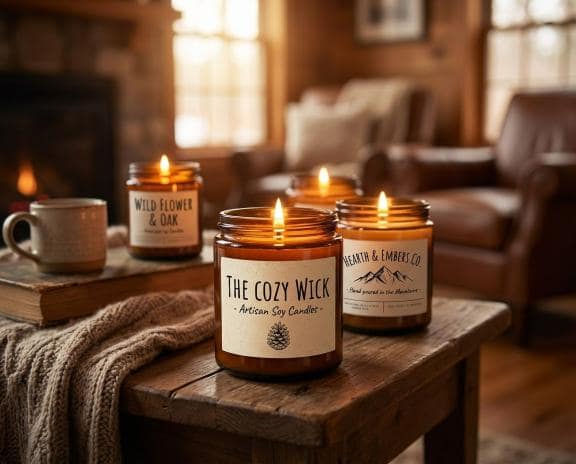
If you’re making candles or wax melts in the UK, you need CLP-compliant labels on every product you sell. This isn’t optional. The regulation is enforced by Trading Standards, and non-compliant products can be pulled from sale and result in fines.
The good news: CLP compliance isn’t complicated once you understand what’s required. This guide walks through everything UK candle and wax melt makers need on their labels in 2026, with practical advice on layout, sizing, and how to get custom CLP labels printed correctly.
What is CLP and why does it apply to candles?
CLP stands for “Classification, Labelling and Packaging” — a UK regulation (carried over from EU CLP after Brexit) that governs how chemicals and chemical-containing products must be labelled for consumer safety.
Candles and wax melts are caught by CLP because they contain fragrance oils, which are chemical mixtures. Even “natural” essential oils trigger CLP requirements because many contain allergens like linalool, limonene, citral and geraniol. If your candle has any scent at all, you almost certainly need CLP labelling.
The regulation is enforced by your local Trading Standards office. They can request to see your safety data sheets (SDS) and labels at any time, and act on complaints from customers or competitors.
What must appear on a CLP label
A compliant CLP label needs all of the following:
1. Product identifier
The trade name or designation of your candle or wax melt. This is whatever you’re selling it as — “Spiced Vanilla Soy Candle” or “Lavender Dream Wax Melts” works fine.
2. Supplier details
Your full business name, registered address, and phone number. This must be a UK address since Brexit (a third-party EU address is no longer enough). If you’re a sole trader, your trading name plus your real address is fine.
3. Nominal quantity
The weight or volume of the product, in metric units (grams or millilitres). For candles, this is the wax weight. For wax melts, total weight of the pack.
4. Hazard pictograms (where required)
These are the red-bordered diamond symbols you see on chemical products. The most common ones for candles and wax melts are:
- GHS07 (exclamation mark) — for products that may cause skin irritation, allergic reactions or are harmful if swallowed
- GHS09 (environment) — for products harmful to aquatic life (very common with fragrance oils)
Your fragrance oil supplier’s SDS (safety data sheet) tells you exactly which pictograms apply to that specific fragrance oil at the percentage you’re using it. If you’re using 8% fragrance load, the SDS will give you classification information that you then apply to your final product.
5. Signal word
Either “Warning” or “Danger” — determined by your hazard classification. “Warning” is most common for candles; “Danger” applies to more hazardous classifications.
6. Hazard statements (H-codes)
These are standardised phrases starting with H-numbers. Common examples for candles:
- H315 — Causes skin irritation
- H317 — May cause an allergic skin reaction
- H319 — Causes serious eye irritation
- H411 — Toxic to aquatic life with long-lasting effects
7. Precautionary statements (P-codes)
Pair with H-codes. Examples:
- P101 — If medical advice is needed, have product container or label at hand
- P102 — Keep out of reach of children
- P273 — Avoid release to the environment
- P301+P312 — If swallowed: call a poison centre if you feel unwell
8. EUH208 allergen disclosure (very important)
This is where most non-compliant candle labels fail. If your fragrance contains any of the 26 EU-listed allergens at 0.01% or more in the final product (a much lower threshold than people realise), you must list them by name with the phrase “Contains: [allergen name]”.
So if your final candle has 8% fragrance oil, and that fragrance is 5% linalool, your final product is 0.4% linalool — well above the 0.01% threshold — so the label must say “Contains: Linalool”.
Your fragrance supplier’s allergen declaration sheet tells you exactly which allergens you need to list. Don’t guess; ask the supplier.
Label layout and sizing
CLP doesn’t specify exact font sizes, but pictograms must be at least 10×10 mm and clearly visible. For candle and wax melt labels, we typically recommend:
- Minimum label size: 50×50 mm for candles in 30cl-40cl vessels, 70×40 mm for wax melt clamshells
- Pictogram size: 10×10 mm minimum (15×15 mm reads better)
- Body text: 7pt minimum, 8-9pt is more readable
- Layout: Pictograms grouped together, hazard and precautionary statements below in clear blocks
Many makers use a wraparound label on the candle vessel that combines branding (top half) with CLP information (bottom half). Wax melt clamshells often use a small dedicated CLP label on the back, with branding on the front.
Wax melts vs candles — different requirements
Wax melts are typically classed as more hazardous than candles because they’re more concentrated (no wick to burn off fragrance) and can look more like food, especially to children. This usually means:
- More precautionary statements required
- “Warning: not food. Keep out of reach of children” particularly enforced
- P102 (Keep out of reach of children) is essentially mandatory
Wax melts often classify higher under CLP than candles using the same fragrance — so don’t assume your candle CLP label works for wax melts.
Material choice: which vinyl works for CLP labels?
CLP information must remain legible for the life of the product. We recommend our waterproof vinyl labels for any candle or wax melt CLP label because they handle wax spillage, fragrance oils, and consumer handling without smudging or peeling.
Avoid paper labels for CLP information. Paper can wick fragrance oils and become illegible, which is a compliance fail.
How to actually print compliant labels
Two routes:
Route 1: We do the layout for you
Send us your fragrance oil’s SDS and allergen declaration, plus your business details, and our free design service will lay out a CLP-compliant label for you. We’ve designed thousands for UK candle makers — we know what compliant looks like. You approve a digital proof before anything prints.
Route 2: You design the label, we print it
If you’re a designer or want full control, lay out your label using the information above and send us print-ready artwork. We’ll print it on premium waterproof vinyl with a free digital proof for approval.
Either way, CLP labels start at £7.99 for 25, with bulk pricing for larger runs.
Common CLP compliance mistakes to avoid
- Forgetting EUH208 allergens. The 0.01% threshold catches a lot of small candle makers off guard.
- Missing the supplier address. You need a real UK address, not a PO Box.
- Pictograms too small. 10×10 mm absolute minimum — many home-printed labels fail here.
- Using the fragrance supplier’s CLP info verbatim. Their data sheet is for the raw fragrance at 100%. You must recalculate for your final product’s fragrance load.
- Not updating when changing fragrance suppliers. Different supplier = different SDS = potentially different CLP requirements.
- Paper labels for CLP. Wax and fragrance oils ruin paper. Use waterproof vinyl.
The Lush Cosmetics Act and what’s coming in 2026
UK CLP enforcement has tightened since 2024, with Trading Standards taking a more proactive approach to small candle makers, especially those selling through markets, Etsy, and Instagram. Expect this to continue. There are no major regulation changes planned for 2026, but enforcement is the area to watch.
The good news: getting your labels right once, with a reliable supplier, means you’re sorted for the long term. Update the labels only when you change fragrances or formulations.
Get started
If you’re a UK candle or wax melt maker who needs compliant labelling, the fastest route is to order custom CLP labels and use our free design service to handle the compliance layout. Send us your SDS, allergen sheet, and business details. We’ll send back a print-ready proof within 24 hours.
For more on label materials, see our full labels range. For artwork preparation tips, read our artwork preparation guide.
Disclaimer: This guide is informational. CLP regulations are complex and your specific obligations depend on your fragrance ingredients, percentages and product type. For full compliance, consult your fragrance oil supplier’s safety data sheets and, where needed, an accredited CLP assessor.
Free delivery, free proof, no minimums.


