For a small business, custom stickers are one of the highest-return marketing investments you can make. A few hundred pounds spent on quality stickers can show up on every order you ship for the next 12 months, every product on the shelf, every piece of customer correspondence — building brand recognition in places paid ads can never reach.
This guide covers 12 specific ways UK small businesses are using custom stickers in 2026, with practical advice on sizes, quantities and how to do each one well.
1. Branded packaging seals
The simplest and most universal use. A custom sticker (50-75 mm round) sealing your mailer bags, tissue paper, or outer boxes transforms a plain courier-delivered parcel into a branded unboxing moment. Customers post photos of well-packaged orders to Instagram far more often than plain ones.
Best for: any small business shipping products to customers.
Quantity: match your monthly order volume × 1.5 for spares.
2. Product labels
If you make something physical — candles, soap, jam, cosmetics, drinks, food — you need product labels. Custom labels on premium vinyl signal quality and let you compete with established brands on shelf presence. See our custom labels hub for product-specific options.
Best for: makers, food producers, candle/soap businesses, beverage brands.
Quantity: match production volumes; small-batch makers typically order 200-500 at a time.
3. “Thank you” stickers in every order
A simple “Thank you for your order” sticker (30-50 mm) included loose in each parcel costs pennies but consistently drives repeat purchases. Adds a human touch that algorithms can’t replicate. See our thank you stickers.
Best for: e-commerce businesses competing on customer experience.
Quantity: 200-1,000 depending on order volume.
4. Sticker pack giveaways
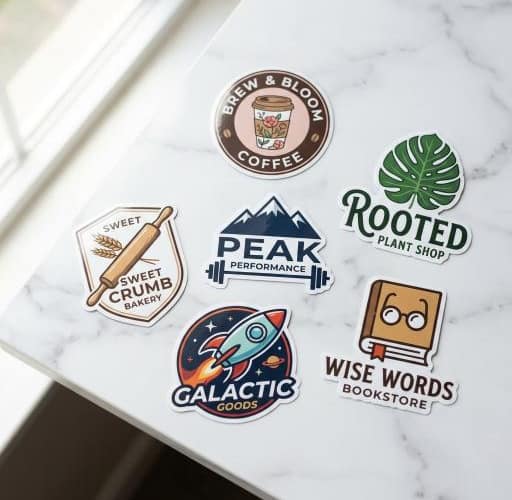
Sets of 3-5 small (30-50 mm) stickers customers can use on laptops, water bottles, and notebooks. The genius: customers actively want them, then become walking adverts everywhere they go. Particularly effective for design-led brands and indie products.
Best for: coffee shops, indie food brands, design-focused businesses.
Quantity: 500-2,000 per design.
5. Loyalty card stamps
Tiny stickers (15-25 mm) acting as “stamps” on physical loyalty cards. Cheaper than custom-printed loyalty cards because you can use blank cards and just sticker them. Adds a tactile, personal feel that digital loyalty apps don’t have.
Best for: coffee shops, cafes, salons, takeaways, juice bars.
Quantity: 5,000+ in tiers, very cheap per unit at high quantities.
6. Event and trade show signage
Vinyl decals for pop-up banners, table-top signs, and booth backdrops. Cheaper than printing rigid signs every time, and you can update designs between events. Reusable on a portable backdrop frame for years.
Best for: any small business with a market stall, trade show presence, or pop-up shop.
Quantity: 5-20 per event.
7. Vehicle branding
If you have a van or business car, custom vehicle decals turn it into a mobile advert. Industry research consistently shows vehicle graphics deliver some of the highest impressions-per-pound of any advertising medium for small businesses.
Best for: trades (electricians, plumbers, gardeners), local services, mobile businesses.
Quantity: typically one full set per vehicle (logo, contact info, side panels).
8. Shop window decals
For bricks-and-mortar businesses, the shopfront window is your highest-traffic billboard. Custom decals for opening hours, social media handles, “open / closed” signs and promotional messages cost a fraction of professional signwriting. See shop window decals.
Best for: shops, salons, restaurants, cafes, gyms, studios.
Quantity: 5-10 decals to fully kit out a shopfront, plus replacements every 2-3 years.
9. Promotional stickers for street marketing
Handing out stickers at events, in customer parcels, or as freebies at your trade stand. The cost per impression is tiny — a £30 batch of 500 promotional stickers reaches potential customers for years. Most effective with a design people actually want to display (not just a logo on white background).
Best for: any consumer brand, particularly fashion, food and drink, music venues.
Quantity: 500-2,000 per design.
10. Bumper stickers for advocacy or community
If your brand has a community angle — supports a cause, has a vocal customer base, or sells to enthusiasts — bumper stickers let your customers display their support. Worked brilliantly for craft breweries, indie game studios, and outdoor brands.
Best for: brands with strong community identity.
Quantity: 500-1,000 per design.
11. Compliance and ingredient labels
If you’re a food maker, candle maker, or cosmetics brand, compliance labels aren’t optional — they’re a legal requirement. Doing them well, on premium waterproof vinyl, signals professionalism. See our CLP labels guide for candle makers specifically.
Best for: food producers, candle and wax melt makers, skincare/cosmetics brands.
Quantity: match production runs.
12. QR code stickers for digital integration
Physical stickers with scannable QR codes linking to your website, menu, booking page, or loyalty programme. The cheapest way to bridge the physical-to-digital gap. Particularly powerful for restaurants, salons and event venues.
Best for: any service business, hospitality, events.
Quantity: 100-500 depending on use.
Budget guide for a small business sticker programme
What you can realistically achieve at different budget levels:
£50 budget — Starter pack
- 200 branded packaging seals (50 mm round)
- That’s it. But it’s enough to add brand presence to every order for 2-3 months.
£100 budget — Standard kit
- 500 branded packaging seals
- 200 “thank you” stickers
- Enough to brand 200+ orders and have a giveaway sticker in each.
£250 budget — Comprehensive launch
- 1,000 packaging seals
- 500 “thank you” stickers
- 200 product labels (if applicable)
- 50 vehicle decals or shop window pieces
- Covers 6-12 months of operations for a small business.
£500 budget — Full marketing kit
- 2,000 packaging seals
- 1,000 “thank you” stickers
- 500 product labels
- 500 sticker pack giveaways (3 designs × 167 each)
- Vehicle decal set + shop window decals
- This is what professionalising your sticker game looks like.
How to design stickers that actually work
Three principles from working with thousands of UK small businesses:
- Make them want to keep it. A sticker someone actively likes the look of gets stuck on a laptop and seen for years. A boring corporate logo sticker goes in the bin. Invest in design.
- Don’t overload them with information. Logo + maybe one piece of info (URL, Instagram handle). Trying to fit your phone number, full address, slogan and three services onto a 50 mm sticker results in something illegible.
- Match the sticker to the customer. A coffee roaster’s sticker should feel like the coffee brand. A children’s craft business should feel playful. Generic “business sticker” templates underperform.
For help with design, every order includes free design service — our team can take your logo and create sticker-ready artwork at no extra cost.
Why stickers beat other small business marketing
- Persistent: a £30 sticker batch keeps showing up for 12 months. A £30 Facebook ad is gone in two days.
- Tangible: physical objects trigger different psychological responses than digital. Stickers feel like a gift in a way an email never does.
- Shareable: customers actually post stickers to social media. Almost no one posts your latest LinkedIn announcement.
- Cheap at scale: per-unit cost drops dramatically at higher quantities. 5,000 stickers cost considerably less per unit than 100.
Get started
For a small business starting out, the highest-leverage first order is usually 500 branded packaging seals plus 500 “thank you” stickers. Two batches, under £100, covers your customer experience for the next 6-12 months.
Browse custom stickers, see our custom labels range, or start with our free design service if you need help getting your artwork ready.
For more specific use cases, see our guides on wedding stickers, bottle labels for craft breweries, and what size stickers do I need.
Free delivery, free proof, no minimums.


